This blog chronicles my (mis)adventures as I travel around the world. Please note, this blog is usually typed late at night while travelling. Excuse any typos and word salad!
Tuesday we had a long drive ahead of us, so Stephen said we
must depart earlier than usual. He
suggested 7:30. We hit the road and travelled only a short distance until he
mentioned that he was going to stop for breakfast because his hotel had not
served any. This was of course conveniently
by a gift shop and a coffee (and liquor) shop. I grabbed some coffee and Aimee walked around
the giftshop for a bit.
Coffee Break
While we were there, another large safari group arrived in 4
vehicles. As they disembarked we
recognized American accents for the first time in Kenya. I called out to one of them, and we talked
for a bit. They were from California and
were touring several countries throughout the African continent.
Driving across SW Kenya
Driving across SW Kenya
Driving across SW Kenya
We got back in our van, and I was struck once again as we
went through some rural villages that there was almost no litter anywhere along
the side of the road. It was at least as clean as Nashville, if not even less
trash. I asked Stephen about how trash
is managed. In my travels to India,
Cambodia, Nicaragua, Thailand, almost uniformly in populated areas of "developing" the
roadside is covered in trash. Culverts
are full of it, and open fields will often have cesspools full of it. Even when we went through Kibera, Africa’s largest
slum in Nairobi, there was not much trash along the alleyways except for what appeared to be a
designated area at the edge of the slum.
Umbrella Acacia Tree in SW Kenya
Driving across SW Kenya
Stephen explained that the government collects the trash
throughout the country and residents and businesses have bins to hold it until
collected. He said there are stiff
penalties and you can be subject to arrest for littering. He also referenced
the single use bag ban which was enacted in 2017, and said before that law was passed a few years ago,
trees and bushes everywhere had plastic bags stuck in them from the wind, but
no longer. He said even cigarette
smoking in public is not allowed to prevent the butts from being discarded. I said that is amazing, because Nashville
intersections are covered in cigarette butts.
Souvenir Shop Somewhere in SW Kenya
Driving across SW Kenya
Three or four hours into our drive, we could begin to see
the clear indications that we were entering into an area populated by the
Maasai. Men everywhere, even if wearing modern
clothing, could be seen also wearing the brightly colored blankets characteristic of the Maasai, usually mostly red in color
with plaid patterns.
As we got into the smaller villages just outside the Maasai Mara we
began to notice there were many areas with small children walking near or
gathered by the main road.Without fail,
every time we passed any they would all look at our van and wave to us.This happened at least 3 times in the several
miles between the village and the edge of the Mara.
At the final stretch approaching our camp, the Mara Leisure Camp, we came to a
river that we needed to cross.There is
a bridge being built, but it is not finished yet, and vehicles have to drive
through the river.Stephen descended the
steep bank of the river right up to the water, and called to someone on the
other side of the river.That individual
came over to the opposite bank, and gave Stephen pointers on where to drive
across.Stephen proceded into the
flowing waters, and we certainly felt the waters pushing the van a bit, however
he was able to get us quickly and safely to the other side.
When we arrived at our lodging, where we’ll be fortunate to stay
for awhile and not have to pack up and
View from Our Porch
leave for three days, we were led to our
lodge, which is a permanent tent with a full bathroom attached. The porch of our tent sits atop a cliff of
about 25 feet with a small river flowing below it. Opposite us on the other
side of the river was the edge of the Maasai Mara National Reserve. After a
relaxing lunch, and a quick nap for Aimee (during which I caught up on blogging) we met
up with Stephen for our evening game drive in the Mara.
Finding Inspiration
Hard at Work on the Blog
Once we proceeded through the gate, Stephen had to jump out
to finish some paperwork.
Unfortunately,
while he was doing this, a group of Maasai women encircled the van forcefully trying to
Warthogs
sell souvenirs. They were extremely
aggressive, sticking their arms into the windows of the car, with their various
crafts they were trying to sell. “No
thank you” was simply met with the offer of a different items. While obviously
their livelihood depends on selling these crafts, half a dozen arms through the
windows of your car does not do anything but create an uncomfortable feeling,
and no desire to buy anything. We continued to decline, and eventually had to
close the windows. Finally Stephen came
back, and we proceeded into the Mara.
Ostrich
We immediately noticed the very different landscape in the
Maasai Mara as compared to the Great Rift
A Very Lonely Tree in the Distance
Valley.
It was very flat, with only gently rolling hills and mostly grassy. You can see for miles in every
direction. Another thing we noticed is
the trails are in much worse condition than near Lake Nakuru. The ground seems to soften quite a bit more
here when it rains, and many areas were completely full of deep ruts, in some
cases more than 24 inches deep where vehicles have gotten stuck in the mud
before.
Topi
In terms of wildlife, we did not have to drive long until we
were surrounded by gazelles, impala, topi, ostrich, and warthogs, and for the
first time saw mongoose, and dik-dik (the smallest antelope, about the size of
a medium sized dog.)
Topi
Skull
After driving a bit deeper into the Mara, at one point
Stephen turned off the main dirt trail on to what
Hippos
barely looked like a trail, with
tall grass growing up between the tire tracks.He meandered between bushes and overgrown areas looking for anything
that may be taking a nap between them. At one point he came to a gorge with a
river at the bottom and said sometimes there are hippo down there.We looked but didn’t see any.He continued along the edge of the gorge a
bit further to a bit of a peninsula on the cliff over the gorge.There were a bunch of hippo in the river at
this point.The river was about 30 or 40
feet below us.He then said, “If there
are no lion around to eat us, we can get out and walk over to watch the
hippo.This was the first time we had
exited the vehicle in any of our drives, so we were a bit apprehensive.Once we put our feet on the ground and walked
over to the cliff’s edge, the incredibly massive beasts swimming in the water distracted
us from our fears.
We spent a bit of time watching the hippos, then got back in
the van and continued onward.On the way
Hippos
out of this area, another safari party came towards us.As he usually did when passing another
vehicle, Stephen would slow down and talk to the driver.(Given the nature of his job, I believe he
knows or at least recognizes almost all the other safari guides.)Aside from exchanging pleasantries, I believe
they also typically share where interesting animals have been seen.
After this exchange, we headed over to another area, where
there were about 10-12 safari trucks all gathered together.Something was definitely going on.We were standing up looking out of the top of
the truck as we arrived late to the party, and Aimee and I both saw something
walking in the grass.With a bit more
urgency and excitement, Stephen hit the gas and squeezed around the other
vehicles (I swore we were going to sideswipe 2 or 3 of them) and placed us in
the front.There were two cheetah standing out in the open at the foot of a tree, surrounded by safari
trucks.We were only about 20 feet from
them, but some of the other trucks were less than 10 feet. This was an amazing
site.The cats looked at us a bit, and
then eventually wandered off between a couple other trucks and went out into
the field.
At this point it was getting late. The park closes at 6:30, and Stephen had to
get back to the gate to not
Hyena
get penalized.However, on the way out, all sorts of other animals started appearing
that we hadn’t seen all day:hyenas,
jackals, fox…So we kept stopping
briefly to look at some of these We finally made it to the gate and pulled
through at 6:31.(Hopefully that was
close enough to not incur a fine.)
From here, we headed back to our camp, enjoyed a nice dinner
and a few cocktails, and headed to sleep in anticipation of a full day of
wandering the Maasai Mara the next day.
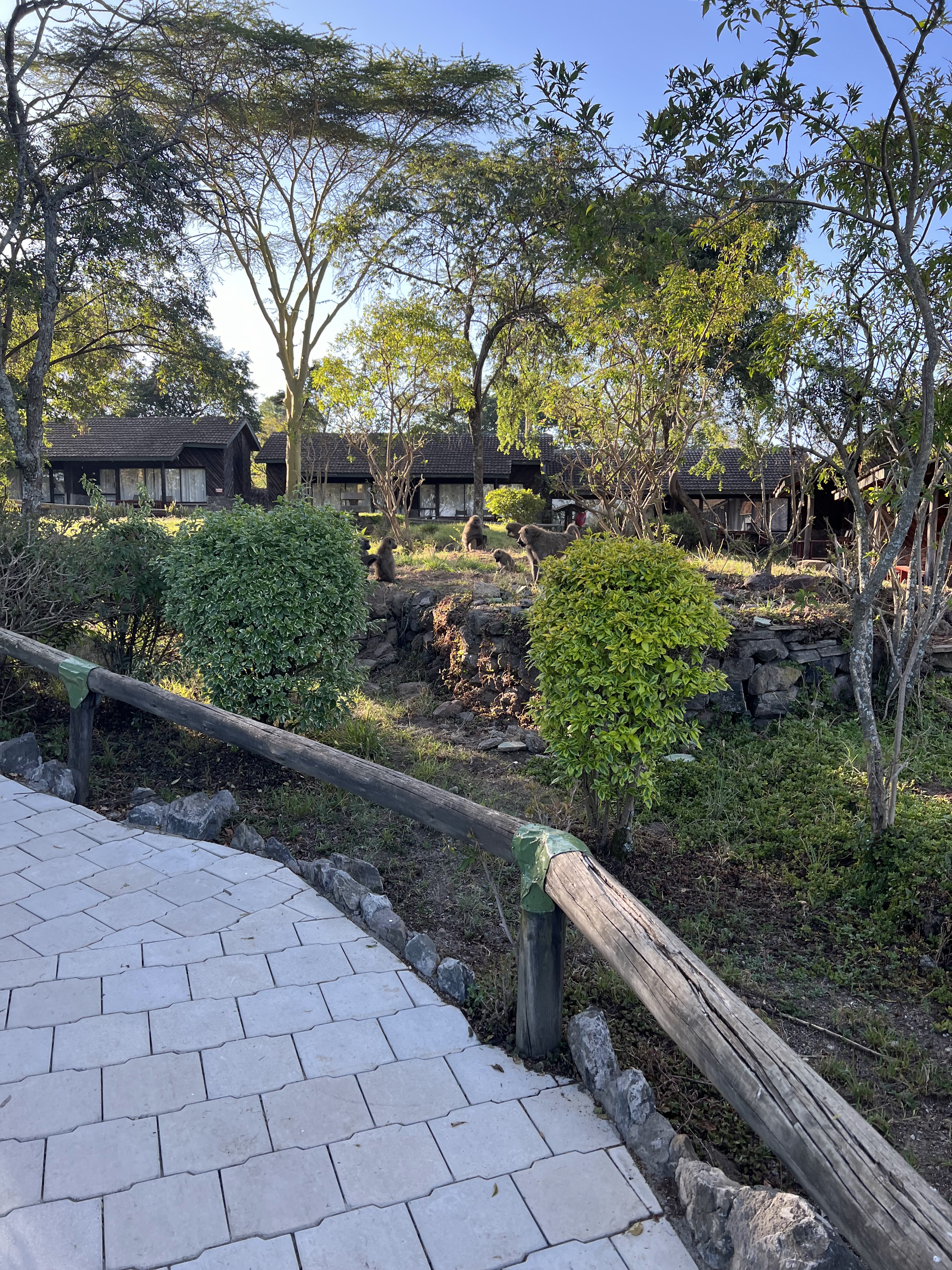
Monday morning we woke up and even before breakfast got to experience some wildlife within the grounds of our lodge, including baboons wandering near the walking paths, a rock hyrax in a tree, and a pair of zebra just outside the fences of the resort.
Rock Hyrax
Zebra Outside the Resort
Baboons (zoom in to center) in Resort
After breakfast, we had a short game viewing drive from
our lodge generally to the exit of the Lake Nakuru National Park.
White Rhino
Buffalo
Eland Antelope
As we neared the exit of the park, the roads
are generally at an incline as we begin to exit the Great Rift Valley. Stephen noticed that the engine was losing
power as we were going up each incline, and regardless of the gear, it seemed
the RPMs would simply not increase beyond idle.
Even on flat land the van was beginning to go very slow. At one incline that was only slightly steep the van couldn’t make it up.
He had to back up and try to gather a bit of momentum and try again. Further on as the van continued to struggle, he got out of the car to check
both the engine from the internal compartment as well as the access panel on
the front of the van. He seemed to think
the fuel injectors had loosened and were not positioned correctly. He attempted to bang them back into place.
When he got back in the vehicle, it seemed to be working slightly better, but
still not right. Each incline that we
came to, you could feel the anxiety among the three of us as
to whether the vehicle would be able to make it.
As continued to crawl back to the exit of the park, Stephen said that we get out of the park we will stop at the mechanic before continuing
onward to Naivasha.He also said,
“Hopefully it is something quick”.We pulled into the smaller streets of the town
of Nakuru lined and found our way to a very small mechanic
shop on a street lined with local shops.Stephen talked with several of the
workers and punctuating the Swahili I several times heard the word “Check
Engine”. Clearly the Check Engine light had come on along with the issues we
were having.At one point the younger
workers walked away, and an older individual (probably my age) came back to
take a look.Stephen told us they had
gone to get the head engineer to diagnose the issue.He gave the car a visual inspection, and
then jumped in to give it a test drive while we remained in the back.After driving around the town a bit, he
pulled us into another shop, which appeared to be a car wash/detailing shop of
some sort. A lot more discussion in Swahili occurred while we sat there, (again
often referencing the Check Engine light).At this point Stephen told us that he had called his office and there
was another vehicle nearby that they would swap if they weren’t able to get
this fixed right away.
Fortunately, after not too much more time they found the issue,
and it was incredibly simple.A wire
that connected to the camshaft sensor had somehow gotten severed resulting in
the issue. They immediately repaired it, and I was able to
see some of the work being done.I don't know the specifics, but a lot of electrical tape was involved.Once complete, the engineer jumped in, turned
the key and revved the engine, resulting in a nice strong roar.We were back in action!The entire ordeal took less than an hour out
of the day.Much of the itinerary was
intended to be relaxing at the lodge, so this was really not much of a setback.
Naivasha was back the way we had come the day before and
was roughly half the distance back to
Nairobi. We arrived at lunch time and pulled into the Enashipai resort.It did not take long to realize this resort
was several notches above the one we had just left on the luxury scale.While our first resort was quite nice, this
one was expansive and exquisite.It
was much bigger, with onsite amenities including conference center, wedding
venue, multiple different spa packages, sauna, pool, bar, a few restaurants, a
night club, and beautifully manicured gardens lawns, and walkways between.If we were visiting Kenya for purely a
relaxing tropical getaway and desired to simply enjoy a resort environment,
this would be a place to do it.However,
Ryan doesn’t generally vacation that way (there is usually not much relaxing
when travelling with me).The resort
also had a path that led to a view of Lake Naivasha with an outdoor bar, and a
fenced off section where some Impala were gathered.
We were offered a bit of free time to grab lunch, wander the grounds, and then meet later in the afternoon for our water and walking safari.
Outdoor Shower
Enashipai Grounds
After getting settled in our luxurious room, which included
a very large tiled outdoor shower off of our bathroom, (as well as an indoor
bathtub that included a shower head and curtain as well), we headed out to meet
Stephen. From our lodge it was only a short drive to the Crescent Island Camp,
named after the small crescent shaped island in Lake Naivasha. This portion of
the tour was a separate tour offered exclusively by that camp, so Stephen handed
us off to Joseph, who would take us on our water safari, and bring us to
Crescent Island for our walking safari.As we walked down to the boat, there were some ruined buildings that we
walked past.Joseph explained that back
in the 70s, the water on the lakes in the valley was much higher.(See yesterday’s post which explains the
Great Rift Valley lake system).As the
water levels dropped over the next 40 years, it was thought the drop would be
permanent as a result of development and irrigation taking water from the water
table that creates the lakes. However, suddenly in 2019 the lakes’ levels rose
considerably flooding may buildings throughout the area that had been built
close to its shores.The lakes have
receded a little bit, and now these flooded structures sit dry, but abandoned.
We came to where the boats were docked. They were long
narrow skiffs, and we climbed in.Joseph
took us out and pointed out the various wildlife in the water---Egyptian Geese,
cormorant, and fish eagle.In one
section of the lake, Joseph directed our attention to what I otherwise would
have assumed were driftwood, and said there are hippos over there.Sure enough as I looked more closely they
were moving, and a couple times they raised their heads out of the water.A smaller younger hippo at point did a belly
roll and for a few second we could see his feet in the air as they came
around.
Hippos
As we pulled further past the hippos, we encountered a few
locals who had waded out waist deep and were fishing in the waters.
Even further on, Joseph turned the boat around towards the
island.Before reaching the island Joseph
slowed the boat about 100 feet from some tall dead trees. He said to us “I have
a fish.Get your video ready and watch
the fish eagle over there.We got ready,
and he let out a loud whistle.He then
threw the fish out into the water, not towards the bird, but far to the side of
us so the bird would have to fly quite a distance to get it.The bird took notice and flew out and
gracefully scooped up the fish mid-flight and went back off into the distance
to eat it.
After this show, we headed to a dock on the island. As we
slowly pulled up, I could see a channel had been dug out of the shallow water.The silt and vegetation that had been dug for
the channel was simply piled next to it to make a make-shift dock.Walking on this dock was a strange sensation,
as the material was mostly old seaweed-like vegetation and was exceptionally
spongey.We were essentially walking
through the edge of the swamp until we got to firm dry land 20 yards further.
At the dock we were met by Peter who was our next
guide.He explained that where we were
walking was currently a peninsula again instead
of actually an island due to the waters having receded a bit since 2019.As we continued we walked past a group of
about waterbuck which were no more than 20
feet from us.They raised their heads
curiously from munching the grass to look at us and see why we were there.
Selfie with the Waterbuck
Beyond the waterbuck were some zebra, which also exhibited some
mild curiosity at the humans walking only a few feet from them.
Selfie with the Zebra
Further on was a herd of wildebeest.Aimee asked if they are at all
dangerous.Peter said they are not
dangerous, and if you get close they will grunt at you, and if you keep walking
they will all run away.
Aimee with Wildebeast in Distance
Wildebeast
As we walked a bit deeper into the island we came across a
handful of giraffe. One of the younger
ones, who Peter said they had named (a name I cant remember…maybe Tom) walked
directly towards us and got about 10 feet away before stopping.Peter said that particular giraffe thinks he
is brave and likes to get closer to the people, but the rest of his family do
not.
Tom the Giraffe
From here we headed back to the boat and ultimately headed
back to camp where we cleaned up and enjoyed some drinks at the bar, dinner,
and a nightcap poolside.
In picking out what sort of safari to embark on, we spent
several hours over a few weeks perusing www.safaribookings.com. I do believe this is the same site I used 15 years ago, and I cannot recommend it enough when considering or booking a safari anywhere in Africa. They have over 10,000 safaris you can compare across the continent from dozens of operators and in an extremely detailed and standardized format. You can filter by country, by cost, by amenity level, etc. Several people have asked me as we planned for this trip about the cost of an African Safari. I heard speculations of $12k - $15k - $20k for the trip. Our cost was a fraction of that. I encourage anyone to peruse that website, and see how reasonable a safari can be. In fact, price is one of the first filters to apply. Note, the fees are generally all inclusive (excluding alcohol), and range from camping in basic tents, to resort style lodges, to luxury accommodations. We ended up with a trip offered by Madukha Tours.
While I typically like to plan out all the details and arrangements of my own trips, I’ve found so far that so much of the sights to see in Africa are its nature and wildlife which is often spread in remote areas across the expansive continent that there is tremendous benefit of leaving it to the experts that have the knowledge of what to see, where to find it, and the equipment to get you in and out of there safely. As our overall trip to Kenya was decided/planned last minute (about 2 months ago) an organized safari made a lot of sense. The package we picked was a mid-range small group safari, meaning you can expect to be in a group of 5-6 people. Oddly when we found a safari with the itinerary we wanted, the title, and the picture of the listing didn’t match the detailed itinerary. It appeared there had been a mistake made when the safari operator submitted the data to Safari Bookings. We reached out and were sure to clarify that we wanted the safari that matched the itinerary, not one that matched the title and picture (and pointed out they may wish to correct the listing, which they did). I had a suspicion that given the conflicting information on the site, others had likely not booked this particular itinerary, and we may be the only ones in the group, as we were booking only a few weeks out. I was correct.
Our schedule had our driver meeting us at 9:00am at our hotel. We had gotten packed up early and were enjoying a leisurely breakfast. I decided to run upstairs to our room to grab something at 8:40 and glanced out the window to see the tour company’s truck already in the parking lot. I ran out to greet our driver, who was named Stephen (interestingly I have noticed virtually everyone we’ve met here has a biblical name), and let him know that we just needed to grab our bags and would be out shortly.
Stephen greeted us with a characteristically warm Kenyan smile and welcomed us to the safari. While he is a bit more reserved than some of the others that we have met over the last few days (I think his English, while certainly fluent, is less strong than others, which lends itself toward a bit more introversion.
Nonetheless, as we embarked on the roughly 4 hour drive to Lake Nakuru, he frequently pointed out animals, vegetation, and other points of interest on the way up there. The trip was on a long 2 lane highway with quite a few large trucks. Much of the drive is on the edge of the Great Rift valley, and on inclines or declines (or even on flat road) these trucks drive very slow, so driving is a constant game of passing long lines of trucks and getting used to seeing the headlights of trucks in the distance coming at you as you pass vehicles. In countries with roads such as these, I always find it best to simply breath slowly and look out the side windows as opposed to the front window. Its much better for the anxiety levels.
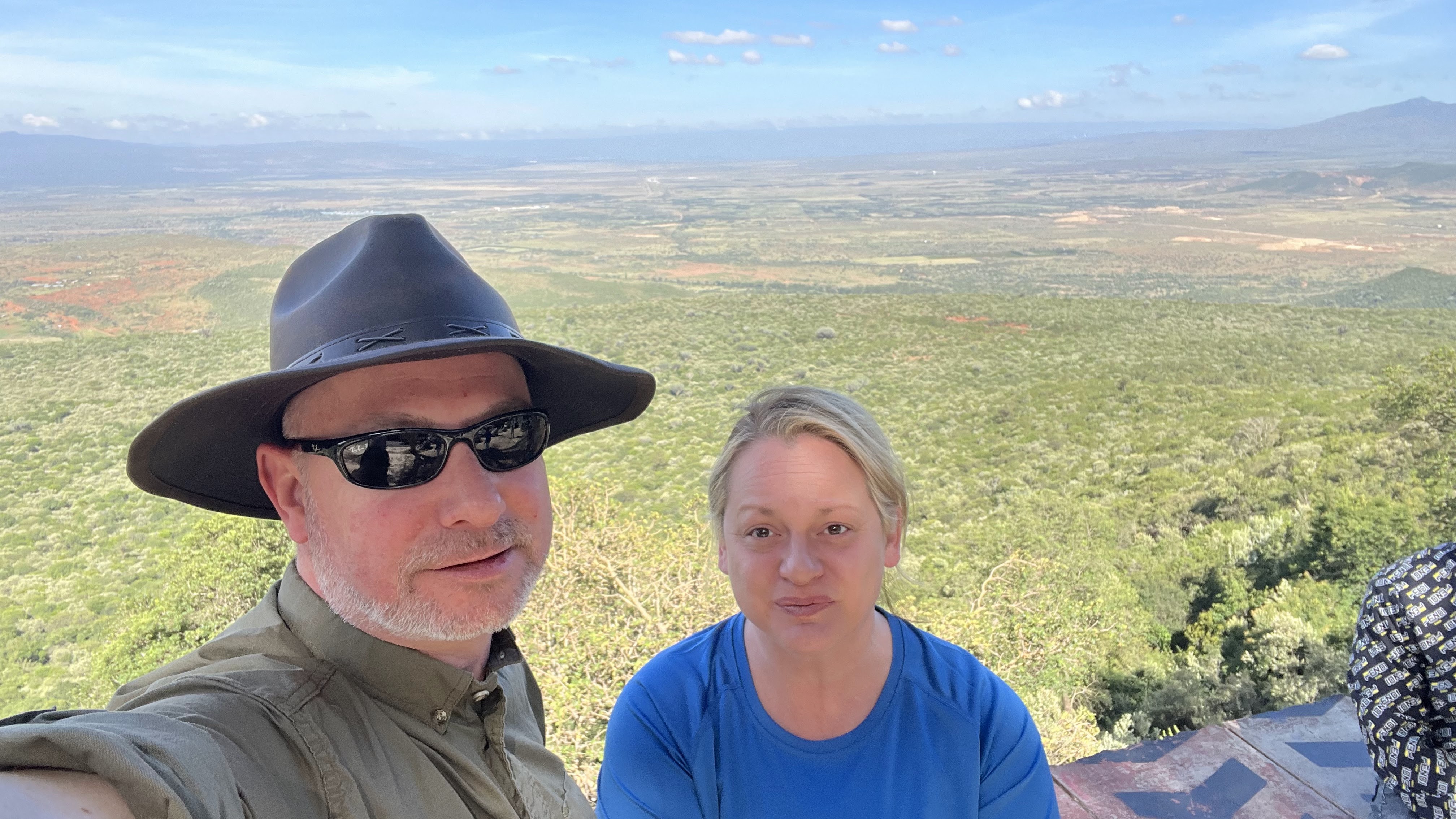
Overlook of the Great Rift Valley
An hour or two into the drive we stopped at a viewpoint where we could get out and take in the vastness of the Great Rift Valley in front of us. It reminded me a bit of standing at the edge of the Grand Canyon, in that your eyes and brain can’t fully grasp the distance and depth of what you are looking at. Its almost necessary to view it in sections, starting at the very edge in front of you, letting your brain interpret the scale of what you are looking at, then visually working your way down, letting your brain reassess, and down further and further to try and create reference points in the vegetation to determine if what you are looking at in the distance is a small shrub, or a large tree that looks like a small shrub because it is so far away. (To give the Grand Canyon its due, the Great Rift Valley is a good margin behind it in its magnificence, but it the visual experience is somewhat similar).
As we stood at the lookout, we ended up talking to a young
local for a bit.In other less developed countries (often described as “the third world”, a
term I’m not particularly fond of) you can often sense the difference between a
casual conversation and an imminent solicitation. I got the sense that at some
point an exchange of money for something may be proposed, but none
occurred.We walked away after a couple of minutes and I felt bad for assuming financial intentions behind the
congeniality.
Before heading back to the van we decided to peek in the
gift shop.Only a few moments later, we
found the young gentleman we had just been talking to appear behind us and
began describing the items we were looking at.While this made sense given my earlier suspicions, I did really
appreciate the lack of pushiness to get us into the shop.I will admit we did not escape the shop
though before making some fairly heavy usage of our credit card.(Aimee didher best to furnish our entire new guest room in one shopping
experience.) As we negotiated our final purchase, the owner(?) of the shop came
over and said to Aimee “please pick out a gift to take with you.”We declined saying we had bought enough but
thank you.He clarified, “No, I mean a
gift from me to you, not to purchase.”We now understood and thanked him, and picked out one more item.I decided to return the favor, and ran back
to the van to grab a box of Goo Goo Clusters to return the gesture with a gift
of a flavor of Nashville.
Now suddenly with a lot more luggage, we piled back into the
van, rearranging our supplies to squeeze in our newly purchased items.
The drive to Nakuru was still a few more hours, and we
continued to take in the sites.Part of
the drive
Italian PoW Church
was a road carved into the cliff side with the Great Rift Valley to
our left.Given the “wild driving”
(compared to American standards) on this two-lane highway and constant passing,
it was even more disconcerting having a cliff to your side that could provide
for an impressively long roll for a vehicle.At
one point we approached an old church, and Stephen explained that the church
was built during World War II for use by the Italian prisoners of war who also built
the highway during that time.
Eventually we made it to the entrance to Lake NakuruNational Park, and stopped at the entry to use the restroom and for Stephen to
register our entry.
Once inside it was a bit of a drive to get to our lodge, and
on the way we made frequent stops to look at the wildlife.We saw dozens of impala, hundreds of
pelicans, some baboons, fish eagle and others.
Impala
Baboon
Zebra
Pelicans (on land) and Flamingos (in Water)
At one point, we saw another safari truck pulled off to the
side by some trees. Stephen told us there is a
Lion
lion in there, and we pulled off
as well.Sure enough, though a little
difficult to see, only about 20 feet ahead of us under a tree there were a few
lions sleeping. I was quite excited, since on my last safari of 7 days in
Namibia in 2012, we did not see a single lion, and here on the first day we
found some.
After watching them for a bit, Stephen attempted to turn the
truck back on to leave, and it would not start.Fortunately, much of the engine area is accessible from inside the
vehicle, and after tipping back the front passenger seat, he was able to access
the battery, where the cable had simply popped off the post.He reconnected the battery, and we started
with no problem.From there we headed up
to the Lake Nakuru Lodge to check in.
This was a resort with a beautiful pool surrounded by a bar
and restaurant with plenty of places to
View from our Porch
lounge.Our room was down a long path that led to a couple dozen
cabins. When the attendees brought us to our room, they showed us the large
sliding glass doors in front of our bed that opened directly upon the open African bush
in front of us.The attendees did warn
us however that there were a lot of baboons in the area and to check for them
before going out (as they can be dangerous/aggressive and also like to steal
things).
After dropping off our bags, we walked back to lunch at the
restaurant. The staff at the resort were overwhelmingly helpful and friendly,
and everyone you walked past smiled graciously and said hello.Walking into the restaurant, a Kenyan man,
with a clear Kenyan accent came out and of a small dining room off the entrance
and said hello and asked where we were from.I said “USA”.He replied
“American!I am American too! I said
“Oh!?Slightly surprised a.) because we
had not seen any Americans since arriving, and b.) because he did still have a
strong Kenyan accent.He followed this with
“But we’ll talk more about that this evening.”Well OK then. “Please come in and enjoy lunch.”
Lunch was a buffet, and we picked out a table, I ordered a
Tusker, and we grabbed our food.Prior
to our trip, we watched “Out of Africa” which is based on the Karen Blixen
story.This took place during the first World
War when Kenya was under British colonial rule.As a result of the popularity of her book and the movie based on it
(with Meryl Streep and Robert Redford), there is a museum outside Nairobi (in a suburb now called Karen) based on it.We decided we weren’t really interested in
going, as it just seemed strange to go to Africa and go straight to the place
famous primarily because a white Danish woman lived there during British Colonial times.
At lunch we reminisced on the movie and the images of the British social clubs,
and government rule, with the Kenyans relegated to servitude. While my (very
remedial) understanding of the true dyanimcs of colonial rule, while it was not slavery as we had in the US, it was
likely only marginally better.
As we sat enjoying lunch, with the other guests who were
mostly European, the almost overwhelming hospitality almost felt as if it
harkened back to that age.We discussed
our own discomfort with this, as we came here to experience Africa and enjoy
the culture and meet people as opposed to simply being pampered by the locals.While the financial dynamic is certainly
different today, with tourism generally supporting as opposed to exploiting the
economy, the obvious stark difference in income levels still leaves a bitter aftertaste, in my mind, of the colonial times.
After lunch we met back with Stephen for our afternoon game
drive. On the way back into the park we
Lion Relaxing on its Back
stopped by the lions again, and this time were able to get a much better view
(though still somewhat obscured by the vegation).As we ventured deeper into the national park
we wandered throughout the many dirt roads and stopped frequently toview the thousands of animals everywhere. Lake Nakuru is one of the many lakes in the
Great Rift Valley.Much of the area is volcanic,
and the lakes are all connected underground.Based on various meteorological as well as agricultural factors, the
water levels may rise and fall.Since
all the lakes are connected, they generally rise and fall together.Stephen explained that up until 3 years ago,
Lake Nakuru which is known for its very heavy population of flamingos would
have sections completely covered in flamingos.However in 2019, the lake suddenly rose and became too deep in many
areas and the flamingos left. There are still a few flocks that frequent (which
on their own seem like a large population), but not nearly as many as prior to
2019. Here are several of the photos we took, but you cannot truly get a sense
of this experience without being there.
Malibu Storks
Rothschild Giraffe
Buffalo
Flamingo
White Rhino
Rothschild Giraffe
"Well hello there!"
After our game drive we went back to the lodge.We ran into the individual again who had said
he was American and talked more with him.I asked him, “So you are from America?”He laughed and said, “Well no of course not.But my daughter is going to University there
and is living in Connecticut and was just gifted her green card.”I congratulated him on that, as I know it is
a very long and difficult process.
Before dinner, a group of six men and women that referred to
themselves as the Friends of Lake
Nakuru Singers sang a few spiritual songs and danced.As they danced, they were a bit forward in
grabbing the spectators from the bar and pulling them into the dance.Some of them (Aimee and myself) obliged for a
bit, some others were clearly not interested in joining.We enjoyed the performance and they passed
around a tip jar (not unlike your typical Nashville bar at all), however the leader
afterwards did become exceptionally pushy in trying to sell his CD.Aimee had turned him away at one point while
I was distracted, but he caught me alone later on, and I caved.The experience did result in us cutting our
evening at the bar short, as we feared further solicitation when we just wanted
to relax.